What is Resilience-Inspired Action™?


Resilience is the capacity to adapt, recover, and continue moving forward in the face of challenge, uncertainty, or adversity. It is not simply endurance or pushing through. It is the active strengthening of the internal and external resources that support wellbeing, growth and sustained progress over time.
Inspired Action is intentional action guided by clarity, values, and purpose. Rather than reacting out of pressure, urgency, or fear, it reflects thoughtful movement toward what matters most.
Resilience-Inspired Action™ brings these forces together. It is the process of building the necessary capacity to take intentional, values-aligned action that can be sustained over time, especially in the face of challenge, uncertainty, or change.
This approach fundamentally shifts the focus away from the fragility of willpower and toward strengthening the foundations that allow change to endure.
The Resilience-Inspired Action Framework™
A six pillars developmental model for building resilience, strengthening capacity, and creating lasting change:
Pillar 1. Capacity - Ground & Regulate
Capacity provides the foundation for engaging with change. Meaningful reflection and behaviour change can be difficult to sustain or endure when we are overwhelmed or relying on limited coping strategies. Capacity focuses on developing the ability to regulate, tolerate discomfort, and remain present enough to engage with the work of change.
Key capacities we build: nervous system regulation, mindfulness and present-moment awareness, stress reduction techniques, healthy routines & body awareness.
Pillar 2. Meaning- Understand Your Story
With regulation in place, reflection becomes possible. This pillar supports making sense of lived experience, recognizing patterns, and understanding responses with curiosity rather than blame. Coherent meaning reduces shame and creates space for growth.
Key capacities we build: narrative reflection, cognitive reframing, self-compassion, pattern recognition.
Pillar 3. Agency - Choice & Self-Trust
As insight develops, the capacity for choice expands. When we're overwhelmed we often make choices on autopilot. This pillar broadens mindfulness to daily micro-choices, strengthens the ability to notice options, pause, and respond with intention rather than react automatically. Agency develops through experience. each intentional choice creates an opportunity to discover that we can influence our behaviour, tolerate discomfort, and respond differently. Over time, these experiences provide evidence that strengthens self-efficacy and self-trust.
Key capacities we build: confident decision-making, problem solving, boundary setting, tolerating discomfort.
Pillar 4. Direction - Define Your Values & Path
When agency is established, attention can turn forward. This pillar helps clarify values, strengths, goals and priorities, translating insight into purpose and answering the question, “What matters now?” In this pillar, you develop a clear vision for the life you want to live and create a path for how to get there. Clear direction makes action meaningful rather than forced.
Key capacities we build: values clarity, vision and future orientation, strengths awareness, purposeful goal setting.
Pillar 5. Action- Aligned & Inspired Action
Action becomes sustainable when it is aligned with capacity, values, and purpose. This pillar emphasizes small, meaningful steps that build momentum, reinforce confidence, and allow learning from setbacks without collapse or self-criticism.
Key capacities we build: sustainable habit formation, behavioural activation, learning from setbacks, supported risk-taking, values-aligned action.
Pillar 6. Support - Supportive Environments & Relationships
Resilience is strengthened and maintained through supportive contexts. This pillar focuses on shaping relationships and environments that protect, reinforce, and sustain change over time, reducing reliance on constant self-effort.
Support is a catalyst for sustainable change. As people move through the earlier pillars, they may become more able to recognize when support is needed, ask for it, receive it, and intentionally shape their relationships and environments in ways that reinforce growth and sustain change
Key capacities we build: Building and maintaining support systems, creating supportive environments, relational boundaries, resource stability.


Example of a Personal Application
When the goal is healing disordered eating and low self-worth, we build the foundations for change by:
Capacity: Moving out of the "fight-or-flight" of body shame and self-criticism. Regulate your nervous system so your body feels safe enough to change.
Meaning: Making sense of the "not enough" narratives and patterns without judgment. Understand the patterns so you can stop living by them.
Agency: Reclaiming self-trust through small consistent choices (micro-choices). Strengthen your ability to choose what supports and nourishes you and build confidence in decisions.
Direction: Clarifying what truly matters to you. Map your actual values and strengths. Move away from external "shoulds" and toward a vision of health that feels aligned.
Action: Taking small, intentional steps. Translate insight into meaningful, sustainable change. Shift from starting over to building habits that hold.
Support: Create the environment and relationships that sustain your growth. Build the external support your change needs to last.
The Resilience-Inspired Action Framework™ is a conceptual framework that synthesizes established principles from resilience science, evidence-based psychotherapy, behaviour-change research, trauma-and-violence-informed practice, public health and lived experience. It brings these perspectives together into a capacity-first developmental six-pillar model for understanding and supporting sustainable change at the individual, team or organizational level. It provides an integrative lens for organizing the capacities that support meaningful, sustainable change. Each pillar builds upon the previous one to help create the conditions that foster sustainable change.
Capacity draws from mindfulness practices, DBT distress tolerance and emotional regulation skills, nervous system regulation, and trauma-informed care to create stability and safety before deeper work begins.
Meaning incorporates CBT processes such as cognitive reframing, narrative reflection, pattern recognition and self-compassion approaches to help individuals understand patterns, reduce shame, and make meaning of lived experiences.
Agency integrates CBT's behavioural flexibility and interrupting automatic patterns, overlapping with ACT's psychological flexibility and DBT skills including mindfulness-based awareness to strengthen intentional responding, decision-making, boundaries, and self-trust.
Direction draws from ACT-informed values work, strengths-based approaches, and motivational psychology to clarify purpose, values, identity, and meaningful goals.
Action incorporates behavioural activation, behaviour changescience, exposure-based principles, and resilience psychology to support sustainable, values-aligned action while building confidence through practice and learning.
Support reflects trauma-informed and relational approaches that recognize resilience is strengthened within supportive environments, healthy relationships, boundaries, and systems that reinforce long-term wellbeing.
Not a checklist but a developmental pathway: The framework is a developmental sequence, not a rigid linear process. Each pillar builds conditions that can make the next more accessible, while people may move back and forth through the framework as circumstances change. Capacity makes reflection possible; reflection reveals patterns; patterns reveal choice; choice builds self-trust; self-trust opens possibility; direction gives that possibility purpose; aligned, inspired action turns it into lived change; and supportive environments and relationships help sustain it. The sequence builds momentum, but people may move back and forth through it as life changes.
Together, the six pillars create an integrative framework supporting individuals in building resilience, emotional capacity, self-trust, and meaningful lasting change.


Why the Sequence Matters
Sustainable change is not simply about knowing what to do. It is about developing the capacity to do something different—and to keep doing it when life becomes difficult.
RIA is intentionally sequenced, with each pillar helping to create the conditions for what comes next. The sequence is a guide, not a rigid progression. People may move between pillars depending on their needs, circumstances, and capacity.
Capacity comes first because meaningful reflection and behaviour change can be difficult to sustain when we are overwhelmed, dysregulated, or relying on a limited set of coping strategies. Building the ability to ground, regulate, tolerate distress and stay present creates a stronger foundation for the work that follows.
With greater capacity, we can begin to explore Meaning—understanding our experiences, recognizing patterns, and examining the stories we have developed about ourselves and our lives. Understanding where our patterns come from can create space to consider whether they are still serving us.
As patterns become clearer, Agency emerges. We begin to notice the small choices embedded within our everyday thoughts, emotions and behaviours. Each values-consistent choice creates new evidence that we can influence our actions and respond differently. Over time, those experiences can strengthen self-trust.
From this growing sense of agency, Direction becomes possible. Rather than focusing only on what we want to stop doing, we can begin asking what we want to move toward: What matters? What do I value? What kind of person do I want to be? What kind of life do I want to build?
Action then translates that direction into meaningful, values-aligned behaviour. Meaningful change happens when what we understand and value begins to shape what we practice, choose, and do. Small, intentional choices create momentum and provide further evidence that change is possible.
And because sustainable change never happens in isolation, Support helps create the relationships, environments, and systems that make change easier to sustain. The people around us, the environments we move through, and the resources available to us can either reinforce old patterns or support new ones.
Together, the six pillars create a pathway from capacity, to understanding, to choice, to direction, to action, with support helping that change take hold and last.
Framework Applications
Individuals use the framework to build resilience, strengthen self-awareness, and create meaningful, lasting change.
Teams use it to strengthen trust, communication, psychological safety, and shared accountability.
Organizations use it to cultivate resilient cultures, support leadership development, and align people, systems, and strategy.


Take the Framework Self-Assessment Tool
Are you trying to make sustainable lifestyle or behaviour changes?
Struggling to make meaningful change stick?
Use this self-assessment to identify your current strengths and growth edge.
In The Works...
Click below to join our mailing list for updates
Book Project in Development:
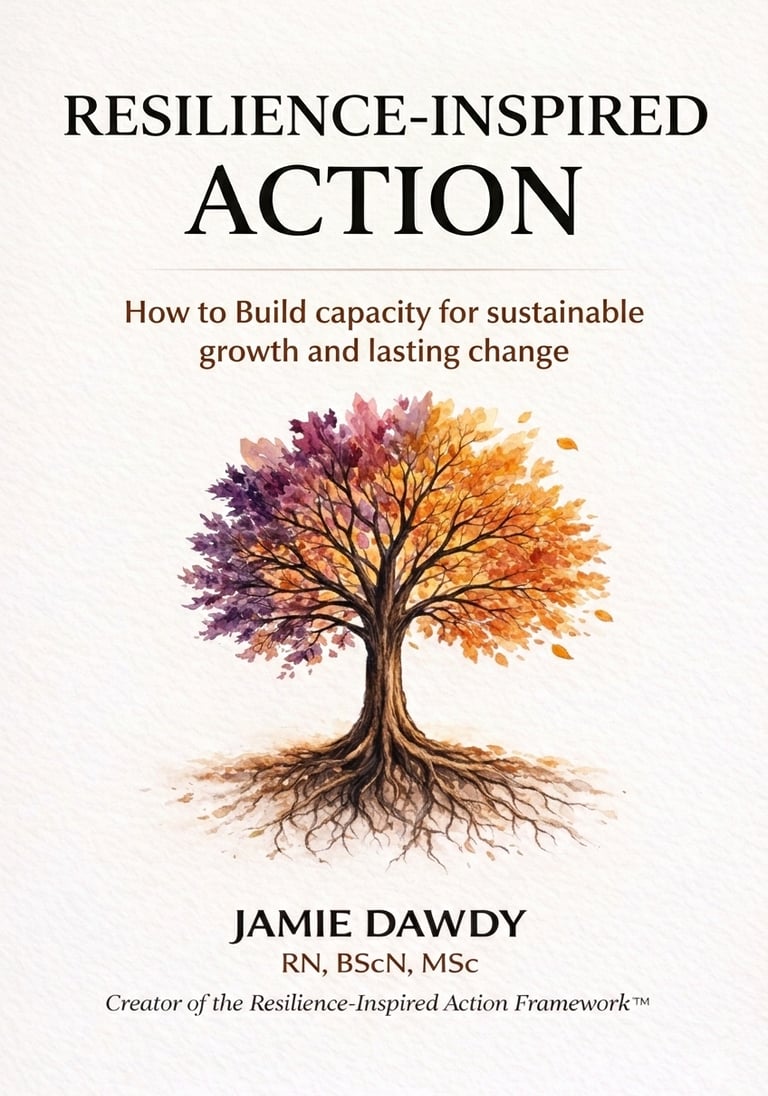
Resilience-Inspired Action: How to Build Capacity for Sustainable Growth and Lasting Change
I'm currently exploring a book-What if resilience isn’t about pushing harder — but about building deeper capacity?
In the "Never Enough" culture, we’ve been sold a lie: that if we just had more willpower, we could finally change our habits, heal our bodies, and find our peace. But insight alone isn’t enough. Motivation fades. And when we try to make healthy behaviour changes it can feel so discouraging when we feel like we're in constant struggle to sustain them.
Resilience-Inspired Action offers a different path.
At the heart of this book is a powerful shift:
Lasting change does not begin with willpower. It begins with capacity.
Through a clear and practical six-pillar framework, readers will learn how to:
Strengthen emotional and psychological capacity
Regulate stress and strengthen coping skills
Examine choices, build self-trust and autonomy
Align action with values and identity
Move from reactive coping to intentional growth
Create sustainable momentum that endures
Foster a network of healthy relationships and build environments that support change rather than sabotage it
Blending clinical insight with accessible storytelling, this book bridges science and application. It is both reflective and practical — offering tools you can use immediately and principles that will reshape how you understand resilience and health.
This book invites you to stop asking, “How can I do more?” and begin asking, “How can I build the capacity to sustain what matters?”